Shipping API integration: labels booked from the order
A shipping API integration books the label with the carrier straight from your order: the rates come in, the label and tracking number come back, and nobody copies an address into a carrier website.
We connect UPS, USPS, FedEx, DHL and TNT, and the main European carriers. Our own order desk ships parts from Hungary to buyers in Europe and overseas this way every working day.
What our own order desk does
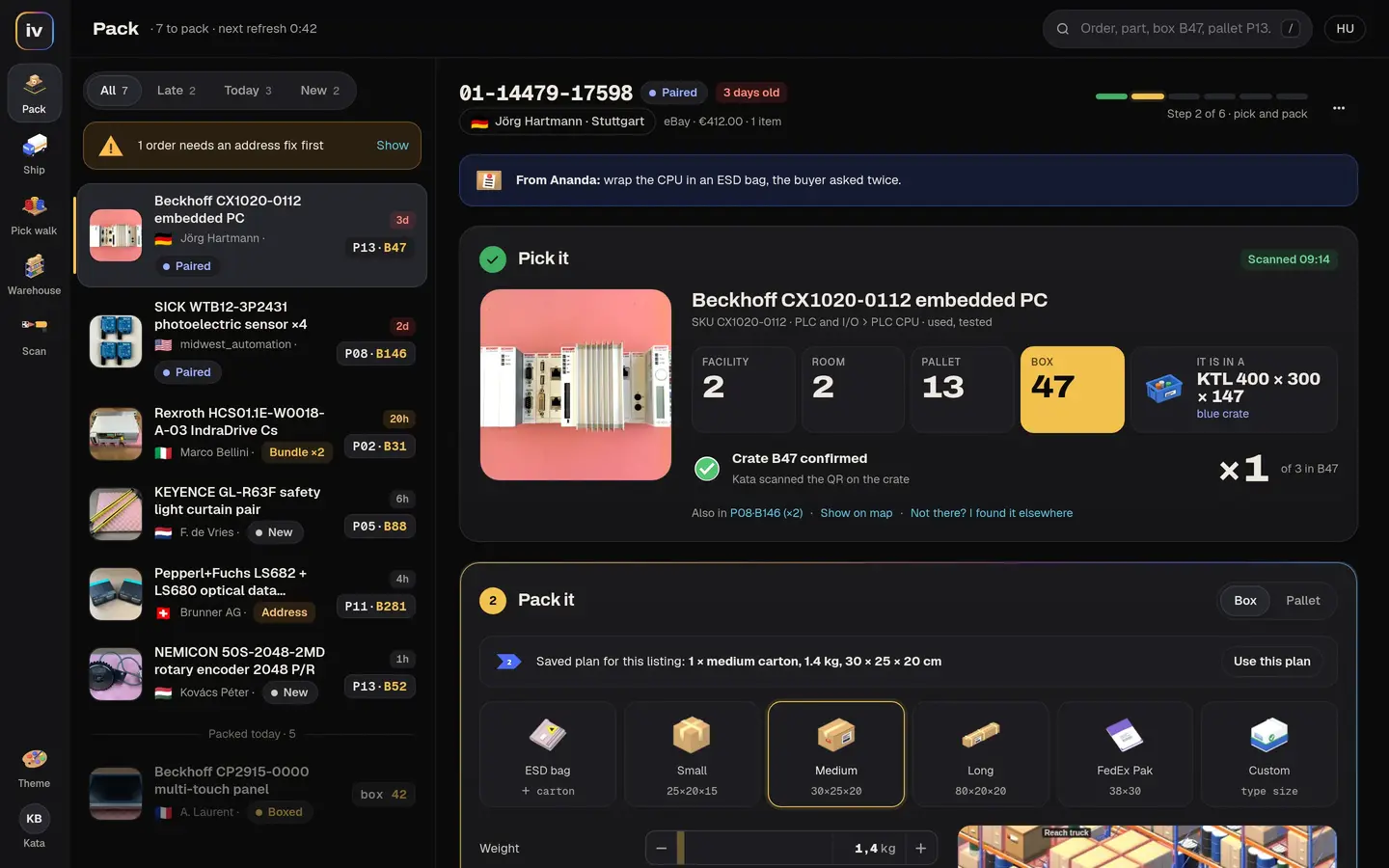
Our parts business ships worldwide. This is the shipping side of the order desk we built for it.
Rates side by side
FedEx rates next to GLS, DPD, UPS and other carriers for the same parcel, before anyone books.
Label and pickup in one step
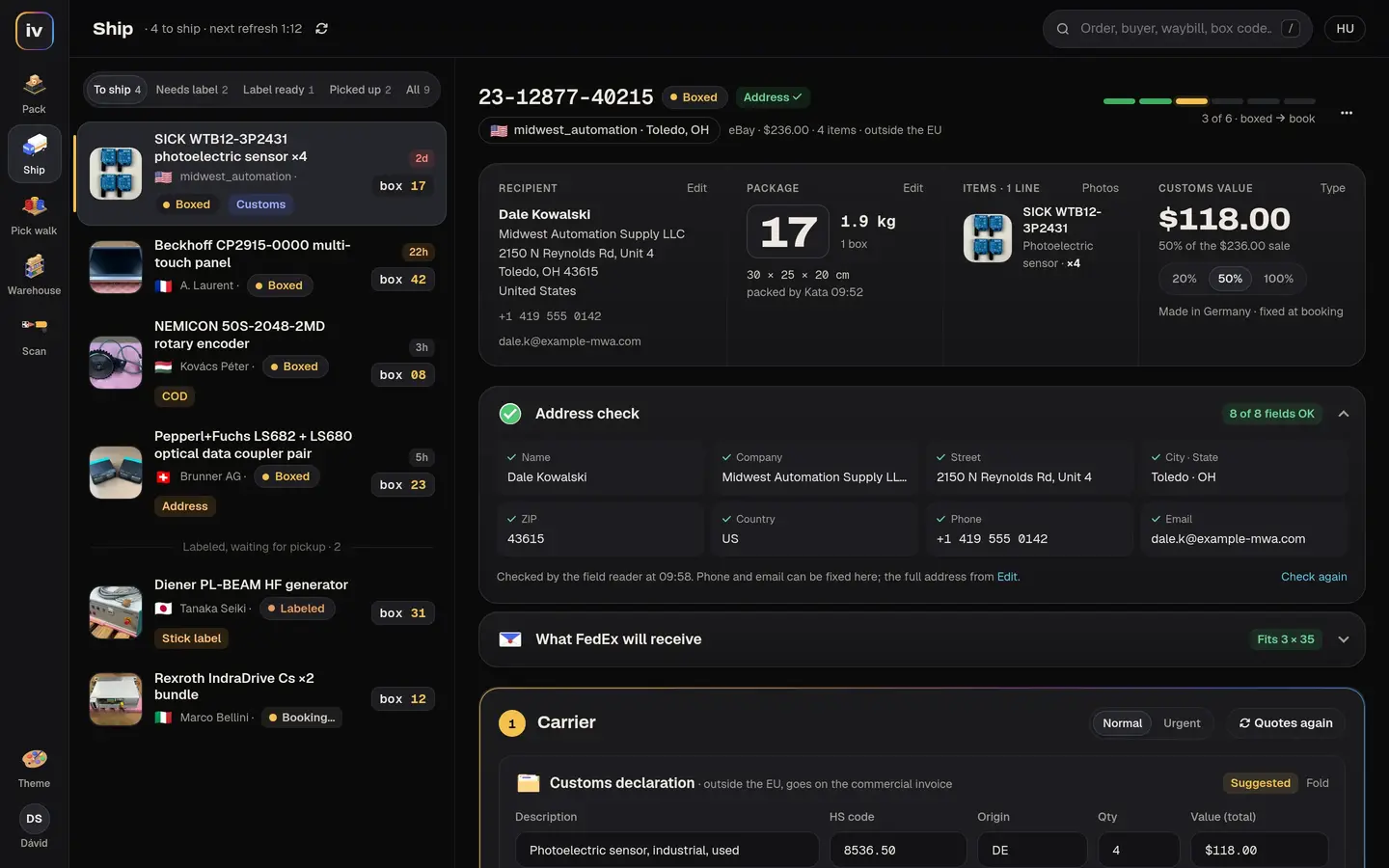
All the labels for an order come out as one file for the thermal printer, and the FedEx courier pickup is booked with them.
Cut-off times built in
Book before half past twelve and FedEx collects the same day. Later bookings move to the next working day, skipping weekends and Hungarian public holidays.
Customs without paper
The customs description and tariff code are drafted for a person to check, and the FedEx customs invoice is filed electronically with the booking.
The carriers’ APIs
Each carrier has its own developer portal and its own sign-in. USPS has moved to new REST APIs with OAuth 2.0 and will retire its older Web Tools interfaces [1]. FedEx publishes separate APIs for shipping and for rates and transit times [2].
When a carrier changes its API, the integration has to follow. That is part of care, so the label button keeps working.
Shipping software you rent may be enough
If you ship domestic parcels with one or two carriers, a monthly multi-carrier tool will print your labels well. We would tell you that on the call.
Custom pays when shipping is tangled up with your own steps: customs forms, invoices, marketplace tracking, pick lists by box. When each one fits
Questions
What is a shipping API integration?
Code that books the label with the carrier straight from your order: rates in, the label and tracking number back, the pickup arranged. Nobody retypes an address into a carrier website.
Which carriers do you connect?
In the US: UPS, USPS, FedEx, DHL and TNT. In Hungary: GLS, Foxpost, MPL, DPD, Packeta, Express One, Sameday, DHL, TNT, UPS and FedEx. See futárszolgálat integráció (in Hungarian).
Direct carrier APIs or a shipping broker?
Often both. We started our own order desk on a shipping broker that gave us the European carriers in one connection, then added a direct FedEx connection for the main lanes, because that route allows electronic customs papers and courier pickups.
Can it handle customs for international parcels?
Yes. For parcels leaving the EU, our order desk drafts the customs description and tariff code for a person to check, and files the FedEx customs invoice electronically with the booking.
Why not use multi-carrier shipping software?
Use it if it fits. We tried the monthly tools; they print labels well, but none of them knew our customs forms or our invoicing, so we wrote those connections ourselves.
Do I need my own carrier accounts?
For direct APIs, yes: the carrier links your account to the developer access [2], so you keep your own negotiated rates. Through a broker you use the broker’s account and rates.
Sources
Read on October 27, 2026. Prices and terms change, so check the current page before you decide.
- [1]USPS Developer Portal New REST APIs with OAuth 2.0 client credentials, to replace the legacy Web Tools interfaces at a future date.
- [2]FedEx Developer Portal Ship API and Rate and Transit Times API among others; FedEx accounts are linked to the developer organization before live use.
Read next
- Custom software developmentWhat we built for an eBay parts seller, coating shops and a recycler, what it costs and how a build runs.
- What is an API?The plain-words answer, with the FedEx label our order desk books every day as the example.
- API integration serviceseBay, carriers, invoicing, payments and Google, connected so nobody retypes an order.
- AI workflow automationWhat AI reads, sorts and drafts for us, and the steps a person always keeps.
- Zapier or a custom integrationWhen a ready-made connector is enough, and when it costs you more than building one.
- The 30-Day AI Workflow SprintOne AI workflow live in your tools in 30 days, with an accuracy target in writing.
- Shopify integrationOrders, stock and invoices between your Shopify store, your marketplaces and your back office.
- WooCommerce and WordPress integrationYour WordPress shop connected to carriers, invoicing and the other places you sell.
- eBay and Etsy integrationOne stock count and one order screen for the marketplaces you sell on.
- Stripe and PayPal payment integrationCard payments, refunds and payouts tied to your orders, invoices and books.
- QuickBooks integrationOrders, invoices and payments into QuickBooks without typing them in.
- Case study: our order deskHow an eBay parts business stopped retyping orders into carrier sites.
Stop typing addresses into carrier sites
Thirty minutes with us. Tell us which carriers you use and what you type for each parcel, and we tell you what we would connect, how long it takes and what it costs.