A catalog of every powder coat color
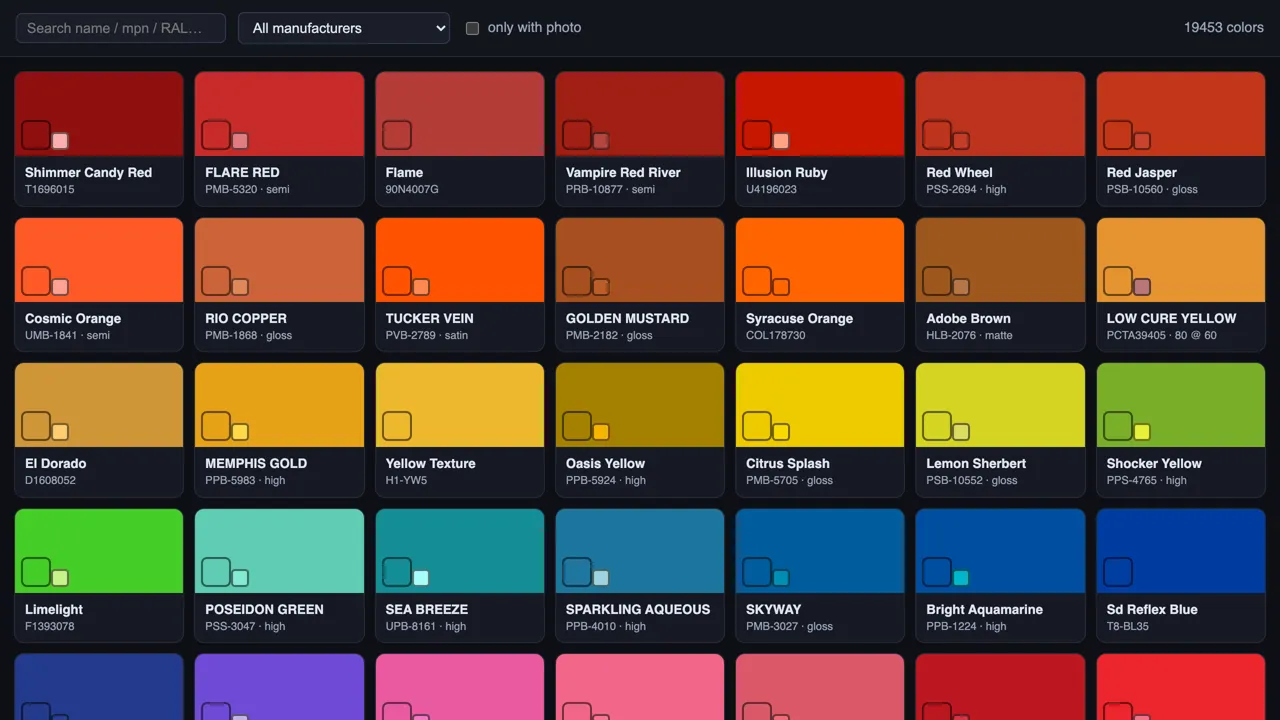
Iron Rainbow's 3D Customizer should only offer powders a shop can buy. Looksmith reads every manufacturer's catalog into one list with a true color for each.
A color picker that has to be true
Iron Rainbow lets a customer color a wheel or a bike frame in 3D and then book a local shop to do it. That promise falls apart if the color on screen is something no shop can order. It also falls apart if the renderer shows a gold metallic as flat mustard. For every powder, the 3D side needs a base color and the finish family, whether that’s metallic, candy, hammertone, wrinkle or one of the rest. For flake powders it also needs the color of the flake.
No manufacturer publishes that. Their colors sit in hosted web shops, home-built shop sites, blog-style pages, PDF color cards, one official spreadsheet and one product database. Some give a RAL code. Some give only a photo of a coated test panel, some a 3D render, and a few give nothing but a name. Tens of thousands of powders, by hand, was never going to happen.
The swatch that came out too light
We started with the biggest powder brand in the US, several thousand colors, each with a photo of a curved coated panel. The first colors we pulled out were all a shade too light. The team traced it to the light: it hits one side of the curve, and that bright flank was pulling every reading up. The fix was to read the color from a band across the middle of the panel and throw away highlights more aggressively. That fix became the heart of the color engine, which the team named Hextractor.
From there the collection grew one catalog at a time, to 21 sources on five continents by June 2026. Each catalog needed its own way in. For web shops we read the product feeds they publish. For others we read the data built into their listing pages, or walked their sitemaps. One manufacturer’s color selector turned out to call a public data service, so we found that once with a scripted browser and then read it directly. PDF color cards went through a parser. Every attempt is written in a log for that manufacturer, the failures too: one site sat behind a bot wall, some country sites were dead, and one server only ever returned errors.
The color engine masks out the background and any shadow or glare, then groups what’s left into a base color and, for flake powders, a separate flake color from the brightest part of the swatch. When there’s no usable picture, a RAL code fills the gap. A filter skips site-wide images, so a brand logo never ends up as a color.
Tuning it by eye
One set of settings couldn’t handle every finish. Dark solids read too light and gold metallics read flat. A black hammertone fools the maths in a different way from a candy red. So each finish family got its own settings, and we built a small review app, styled like Iron Rainbow’s own admin, to tune them. It shows every swatch next to the color pulled from it and recalculates live as you move the sliders. You can filter by the manufacturer’s own categories. A reviewer marks each family as seen and then as confirmed, and only confirmed families are allowed through to the platform.
What reaches the 3D side is small and strict. Each powder carries one of 13 families, from Solid and Metallic through Hammertone and Candy to Holographic, Chameleon and Disco, plus a base color. Flake powders add a list of flake colors of whatever length they need. The renderer takes those and applies them to a template for that family.
Mistakes we undid
Two early choices had to be reversed. The first importer turned every powder into a ready-made 3D look, and thousands of them flooded the carefully picked list customers see. Now the importer brings in powders only. A powder becomes a look when a person in Iron Rainbow’s admin builds it and approves it, because a look carries finishing touches no importer can guess.
The second was a single color field. A purple flake on a black base came in as a purple powder. Base color and flake color are now separate fields.
We also learned to be polite. When one manufacturer’s data service started refusing connections after we had pulled the full catalog several times, the rule became slower, rarer refreshes.
The direction came from the founder in short notes: every catalog, powders only, every region where shops buy powder, and thumbnails that look alike. Much of the scraping was run by AI coding agents, and every worry went into a readiness list and only turned green once someone had checked it.
Waiting at the door
Looksmith has pulled colors for nearly every product it has collected, and the importer can be rerun safely without creating duplicates. It fills in each powder’s chemistry from category codes, technical sheets and part numbers. A trial run against the full set passed clean for 22 manufacturer labels. The live import is waiting on access to the production database. The biggest catalog is tuned and going through confirmation family by family. Japan, South Korea, France, Spain, the Nordics, the Benelux countries, Central and Eastern Europe and Turkey are still to be covered.
Keep reading